Before you commit, what still needs deciding?
Change does not wait for a neatly labelled next stage.



Change does not wait for a neatly labelled next stage.
You might be preparing a website, launching a service or trying to explain an offer that has become more complicated over time. Each project inherits assumptions about who the business is for and what customers need to understand. Those assumptions may be sound, or people may have been working from different versions for years without discussing them. Often the first person to expose the gap is the designer, writer or agency asking what the new work is meant to achieve.
The purpose of pausing is to make the commitment better informed. It should help the business move, rather than create an indefinite strategy exercise around every decision.
An early page structure or campaign line can often be revised without much consequence, while a new business name, restructured offer or public service promise can be harder to reverse. Consider what the work would commit you to, which decisions other people would build on and what uncertainty could materially change the direction. That helps you judge how much investigation is worthwhile, rather than trying to remove every doubt before moving forward.

Be specific about what the business is trying to make possible. More consideration in an existing market, a coherent broader offer and credibility for a new kind of work are different jobs. Define the intended contribution and the part this project can reasonably play. A website may help customers understand and assess an offer. It cannot independently ensure there is demand, sales capacity or a viable delivery model.
Understand the people involved, the circumstances that prompt action and the alternatives they consider. Check how much is based on actual conversations, sales evidence or research, and how much is an internal view. Agree whose questions the work must answer. If it serves several audiences, identify the shared offer and the differences that justify separate routes. Avoid treating an imagined persona as an established fact.
Clarify what someone can buy, what is included and how the parts relate. Does a new service extend the existing promise or require a different explanation? Will customers understand where to start? An expanding business can accidentally present its history of additions rather than an offer a customer can navigate. Structure the offer around a sensible relationship, with the economics and delivery implications checked by the business.
Agree what you want people to understand about the business and which strengths matter in the situation you are addressing. Purpose, values and ambition can help shape that position when they affect what you offer, the evidence you provide or how customers experience you. A commitment to thoughtful advice, for example, becomes more useful when people can see how it changes the service.
Look at the examples, qualifications, data and experience that support your claims, including the permissions and limits attached to each piece of evidence. Then discuss the promise with the people who will deliver it. If it depends on a faster response, different service or additional expertise, those requirements need resources and someone responsible for them before they become commitments in the copy.
Agree what changes in identity, communication, sales and experience. Identify who needs to participate, who can decide and who will carry the work forward. The output might be a more useful brief, a coherent offer structure, an agreed position or a practical implementation sequence. It does not have to be a new identity or a comprehensive strategy document.
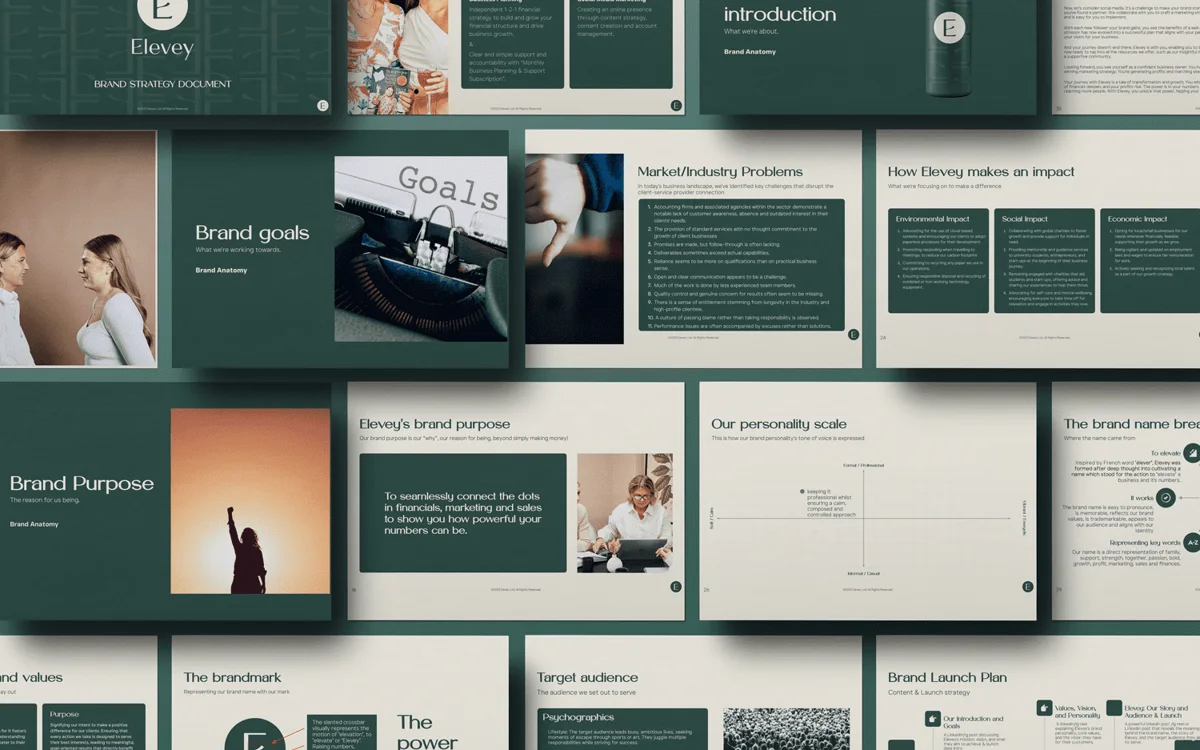
Elevey provides one example of a particular change. The business was expanding beyond its earlier founder-led identity, with a wider team and the addition of a marketing arm. The work examined the business and brand before developing a new name, identity and website through 9 Designs. [1] That was an appropriate scope for those circumstances. It is not a rule that every new service requires a rename or rebrand. Sometimes the commercial direction is already clear. You may need to improve how it is expressed or make an agreed strategy usable. Begin with what is sound, identify the relevant gap and choose a proportionate scope.
Elevey · a new name, identity and website through 9 Designs
Read the project account (opens in a new tab)For each of the six decisions, choose one of three descriptions.

The practical component for this article is loading.
These are discussion labels, not scores. An assumption is not automatically a reason to stop. Ask how much the proposed commitment depends on it and what you could do to reduce the uncertainty. For each important gap, record the question, the evidence needed, who will decide and when the project needs the answer. A short customer conversation may be sufficient for one issue. Another may need more substantial research, commercial analysis or specialist advice.
Before bringing someone in to help, make sure you can explain what decision the work is meant to support, who needs to participate and what information is required. You should also understand what you will receive, how it will be used and where the scope begins and ends. That can be a bespoke engagement, focused workshop or review of existing work, provided the initial commitment has a practical purpose and any further work is agreed on its merits.
This is the role of alignment here. The people shaping and representing the brand need enough shared understanding to make informed decisions. The commercial purpose is to help the business use its brand more effectively.
Use these prompts to create a short working note.
Practical component
Your notes stay on this page and are not sent to Kiki. Copy or print them before you leave.
Copies the descriptions and notes you chose on the board above into the third prompt. Nothing happens unless you press it.
Share that note with the people making and delivering the commitment. It should make the next conversation more useful and help avoid a beautifully executed answer to a question the business has not properly considered.
Change will continue. You can build a better habit of noticing when a brand decision needs attention and making it deliberately, with enough evidence to move forward.
Back to topSources
Continue the thinking

Customer experience12 min read
A visit to the dentist with my child raised a bigger question: how can the way you look after people create an experience they remember, trust and tell others about?
Before you sign it off
Let’s discuss the situation, the decisions already made and what would help you move forward.